
Glossary | New to watches | Size and fit guide | Why Christopher Ward? | Our categories | CW’s models explained | Down the rabbit hole | Buying from us | Selling to us | SHWC – beyond CW
CW’s models explained
This section is currently work in progress. It will explain Christopher Ward’s model families through the lens of the ten Ward Hoard categories. Each category contains multiple CW model families beneath it giving you a clear, structured view of how CW’s entire back catalogue fits together.
In this (mammoth) guide, we’ll cover content such as:
the model families behind each Ward Hoard category;
their design purpose and historical context;
the differences between generations;
strengths, weaknesses and real‑world wearability;
movement evolution across families;
limited editions and rare variants;
what to look for when buying pre‑owned; and
how each family fits into CW’s wider design story.
If any of the jargon (and there’s plenty of it!) leaves you scratching your head, our glossary breaks everything down into simple, friendly explanations.
Finally, corrections welcome - if we’ve got to the end of this magnum opus without making at least one mistake, I will eat my hat.

1) Curator’s collection
We start with an easy one. The Ward Hoard Curator’s collection is simply the special CWs that we like the most. They could be drawn from any style, collection or range. Constantly changing, it’s our choice, our decision, our whim.
2) Halo
The Ward Hoard Halo collection is inspired by CW’s own current Atelier collection. CW defines it as “The home of our most advanced timepieces and movements. Horological innovation, in-house calibres and award-winning watches – direct from our atelier in Biel, Switzerland.”
But the ideas behind Atelier began long before the label existed. From the earliest days of the brand, CW experimented with complications, movements and case construction that signalled a level of ambition far beyond what most young independents attempt. The modern Atelier collection is simply the latest evolution of that story.
This section presents CW’s Atelier‑grade watches in chronological order, from the earliest boundary‑pushing projects to the modern architectural showpieces. When we get these in, this is the category in which they will sit.
2.1 JJ calibre era (2011–present)
The first true signs of CW’s technical ambition appeared in the JJ calibre series, developed with Johannes Jahnke. These were modular complications built onto proven Swiss bases - affordable, serviceable, clever and mechanically distinctive. There is an excellent article here that explains the development behind them.
2.1.1 JJ01 - C9 Jumping hour
CW’s first complication, and still one of its most charming. Instead of the hour hand slowly circling the dial, JJ01 shows the hour through a small “digital” window. The minute hand sweeps around as normal, but at the top of each hour the number in the window snaps instantly to the next one.
It’s a tiny moment of theatre — a crisp, satisfying jump that you can’t help but notice. What makes it special is how natural it feels in everyday use. You glance once and immediately know the hour; you glance again and enjoy the motion of the minute hand catching up.
Beneath that simplicity is a clever mechanism that stores energy over the course of each hour and releases it in a precise burst to make the jump happen cleanly. It’s playful, distinctive and quietly ingenious — the kind of complication that makes you smile every time it does its little trick.
JJ01 set the tone for CW’s early creativity and remains one of the most memorable projects in the brand’s history. This calibre (movement) has been used in multiple watches since.
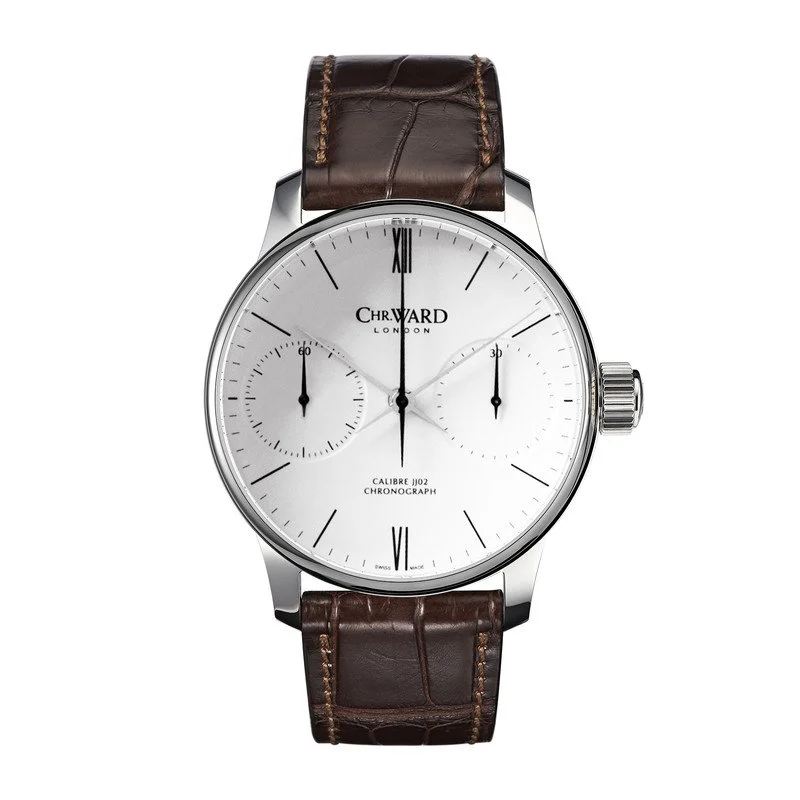
2.1.2 JJ02 - C900 Single pusher chronograph
A chronograph you control with one button — start, stop and reset, all through a single pusher in the crown. That’s what makes the JJ02 so satisfying: each time you click it, there is a lot of cleverness happening underneath so the action is crisp, positive and repeatable.
CW built JJ02 on a hand‑wound Unitas base and re‑engineered the chronograph works so you can actually see what’s going on through the big display back — column wheel turning, clutch engaging, minutes racking up. It was a bold move for a young brand, and it still feels special today because monopushers remain genuinely rare.
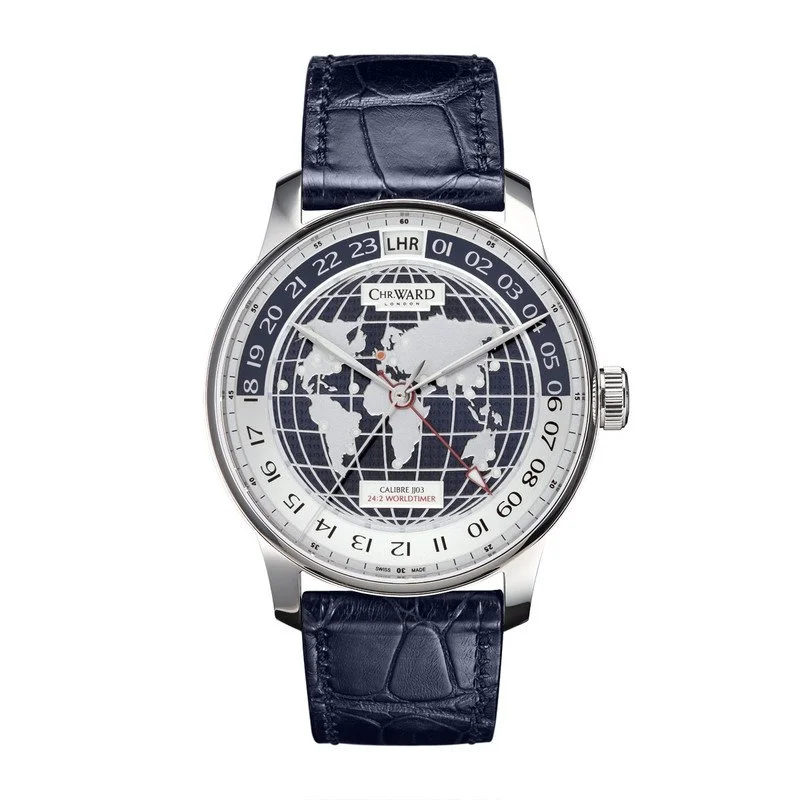
2.1.3 JJ03 — C900 World timer
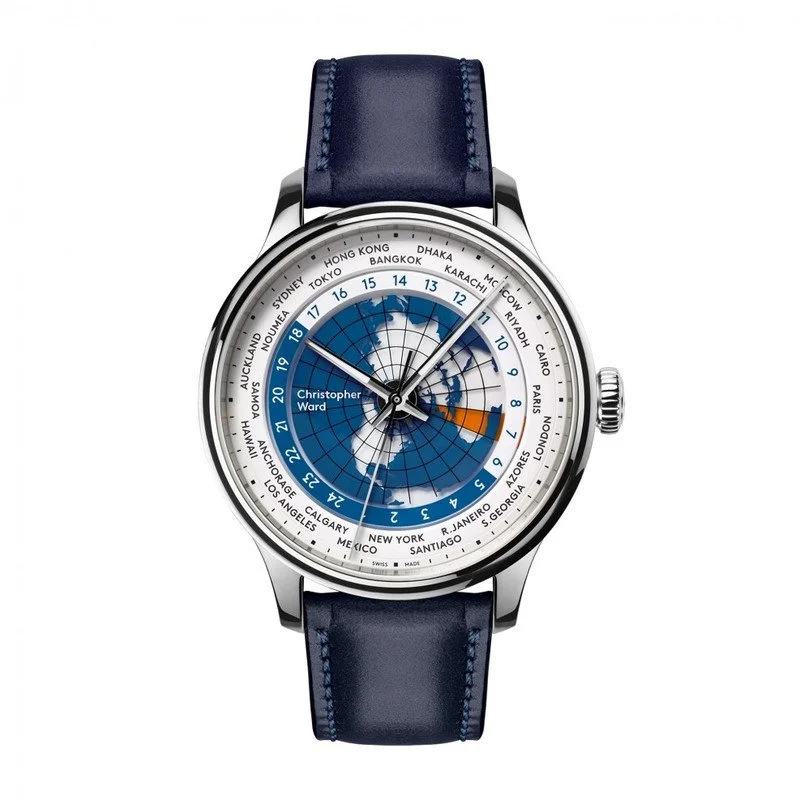
JJ03 is CW’s answer to “show me the whole world at once.” Based on a proven GMT calibre and re‑worked in‑house, it drives a 24‑hour ring and city disc so you can read multiple time zones at a glance. Not a busy pilot’s panel, but a clean, dress‑leaning worldtimer with a map that actually invites you to use it.
The later C1 Grand Malvern Worldtimer refined the display again: the main dial reads like a normal 12‑hour watch, while the 24‑hour ring circles the map and cities, making it intuitive to read day/night across the globe.
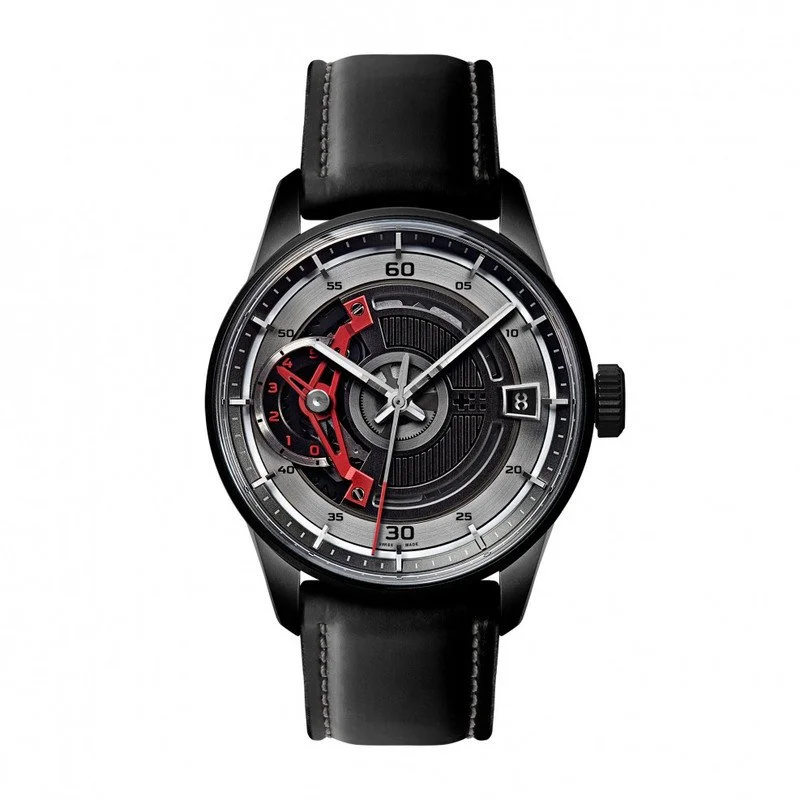
2.1.4 JJ04 — C9 Moon phase
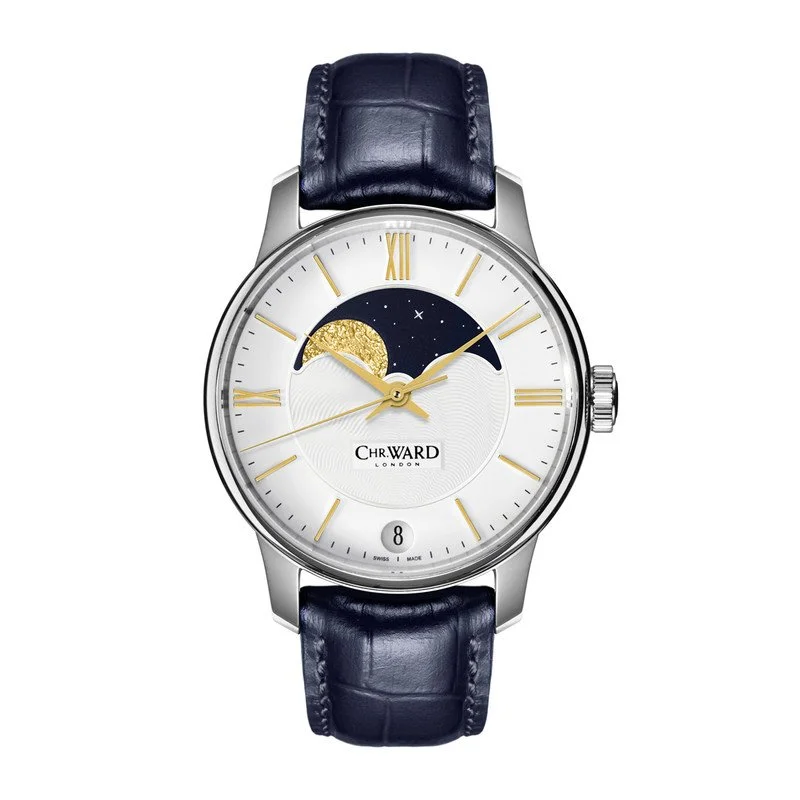
The JJ04 calibre is one of the most mathematically precise and technically accomplished complications Christopher Ward has produced. Instead of relying on the standard 59‑tooth moonphase wheel found in most movements, CW developed new gearing that dramatically increases accuracy.
As a result, the moon disc remains correct to within one day every 128 years. It’s a remarkable piece of engineering - refined, beautifully executed and far more precise than the moon phase displays found on many far more expensive watches.
2.2 SH21: CW’s in‑house movement (2014–present)
In 2014, Christopher Ward did something extraordinary: it launched a modern, modular, chronometer‑grade in‑house movement. And to understand why this was such a big moment, you almost need to zoom out and look at the watch world as a whole.
Most brands, even those with a century of history, don’t make their own movements. Not because they can’t, but because it’s incredibly difficult, incredibly expensive and incredibly risky.
Designing a movement from scratch means years of engineering, prototyping, testing, breaking, refining and starting again. It requires patience, deep pockets and a team that truly understands mechanical watchmaking from the inside out. It’s the sort of thing only the biggest Swiss maisons usually attempt.
So when CW, still a young, ambitious company, decided to build its own calibre, it was a statement. SH21 wasn’t just a new movement; it was CW saying, “We belong in the serious end of watchmaking.”
When CW first unveiled SH21, the reaction within parts of the Swiss industry was as telling as it was amusing. One well‑known manufacturer reportedly asked Mike France, “What gave you permission to develop your own movement?” It was meant half as a joke, half as a genuine expression of disbelief. Young brands simply weren’t supposed to build their own calibres — especially not those without a century of heritage behind them. The idea that Christopher Ward had gone ahead and done it anyway perfectly captured the spirit of SH21: ambitious, independent, and quietly defiant.
What made SH21 special wasn’t just independence for its own sake. It was what the movement delivered:
a 120‑hour (five‑day) power reserve using twin barrels;
chronometer‑grade architecture capable of serious accuracy;
a clean, modern bridge design;
a modular layout that allowed future complications; and
real‑world robustness that meant it could be worn daily, not just admired.
In a world where many heritage brands outsource everything, SH21 was CW stepping up and proving it could do the hard, unglamorous work that sits behind true watchmaking. It changed the way collectors saw the brand and it remains one of the clearest examples of CW’s ambition – not just to make good watches, but to create them from the inside out.
SH21 wasn’t just a movement. It was CW growing up in public – and doing it with confidence, intelligence and a very British sense of purpose.
CW has used the SH21 movement across a large number of watches since 2014. The designs vary - dress, field, sports, limited editions, but all share the same five‑day, twin‑barrel architecture that defines the calibre.
We won’t list them all as there are so many, but they include the C9 5‑Day Chronometer, C8 Power Reserve, various C60s and C65s.
2.3 Apex: SH21 made architectural (2019)
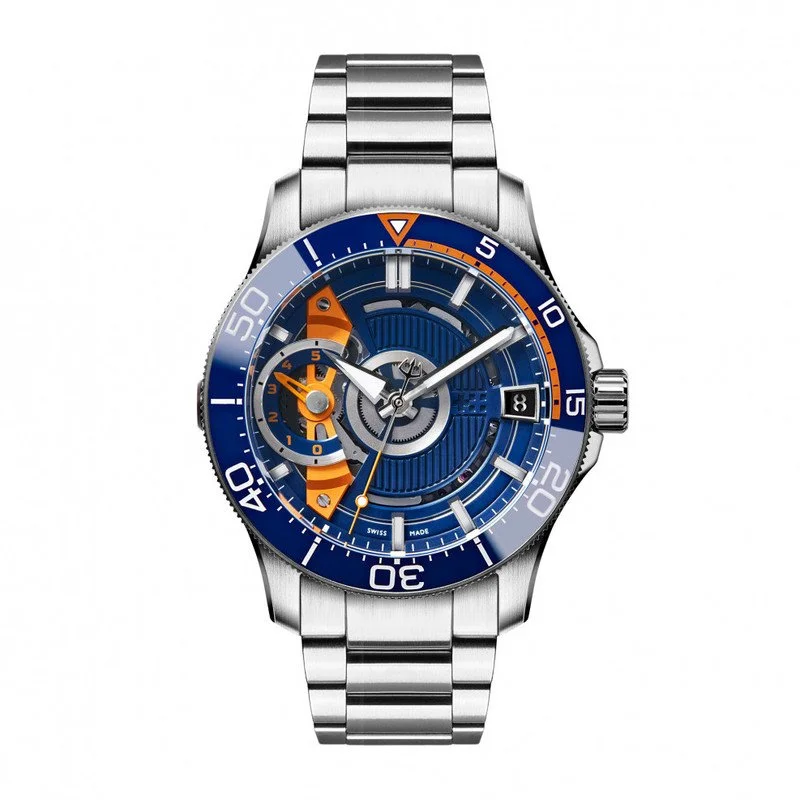
The development of the Apex range (the C60 and C7) was the moment CW decided to stop hiding SH21 and start celebrating it.
Instead of keeping the five‑day movement tucked behind a dial, CW opened it up, layered it, and turned it into something architectural and alive. You can see the twin barrels breathing, the gear train in motion, the colour accents guiding your eye across the mechanics.
What made the Apex models special wasn’t just the look — it was the collaboration behind it. CW worked with Armin Strom, one of Switzerland’s respected independent ateliers known for open‑worked movement architecture. Their influence meant the Apex models weren’t skeletons for the sake of it, but a watch built around clarity, structure and mechanical display.
The Apex range proved something important: SH21 wasn’t only a technical achievement, but a piece of engineering worth showing off. It marked a shift in confidence - CW wasn’t just making movements; it was ready to treat them as design objects in their own right.
2.4 C60 Concept: SH21 made transparent (2021)
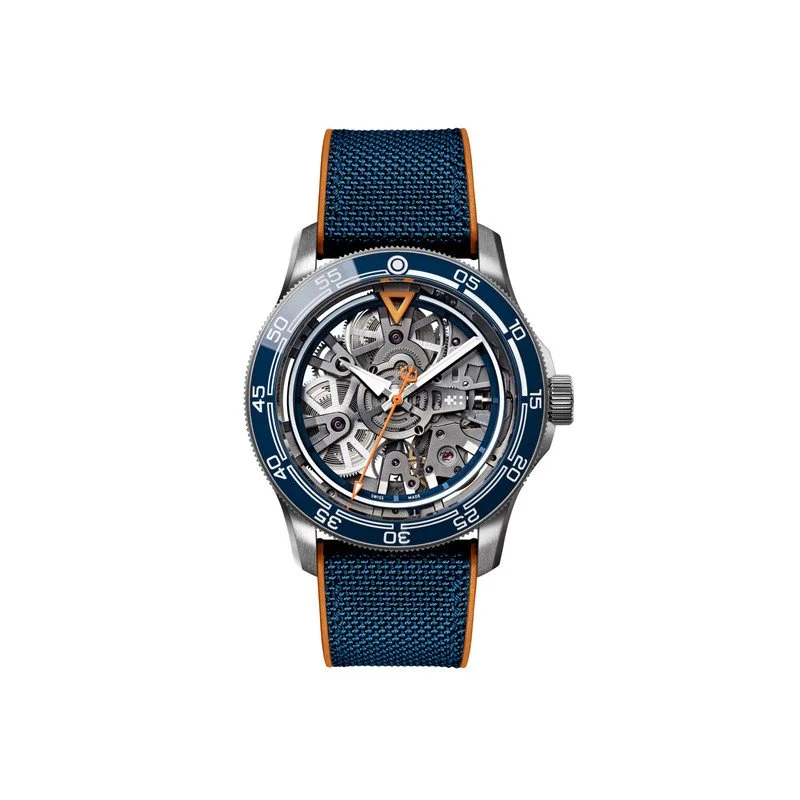
The C60 Concept takes the idea behind the Apex models and pushes it further. Instead of adding more cut‑outs or colour, CW re‑built the watch around clarity. The case is titanium and the dial and upper structure use sapphire, giving a clean, open view straight into SH21.
The result isn’t loud or showy – it feels calm, spacious and almost weightless. Up close, the finishing stands out. The bridges and edges carry hand‑polished chamfers, the kind of detail that takes time and repetition at the bench. They’re not there to be flashy, just to bring a subtle highlight to the mechanics as light moves across them.
On a watch with so much visible movement, those small touches matter. Working with sapphire is slow and demanding. It’s incredibly hard, so machining and finishing it takes far longer than steel or titanium. Getting the dial structure perfectly aligned so the movement sits cleanly beneath it is patient, meticulous work. The result is quietly impressive.
The Concept gives you an almost panoramic view of SH21 – the barrels, the wheels, the bridge shapes – all sitting under a sapphire plane that frames everything neatly.
2.5 Bel Canto: the breakthrough (2022–present)
Bel Canto is the watch that made people look at CW differently. It introduced a sonnerie au passage – a mechanism that chimes once on the hour – but did so with a sense of lightness and play rather than formality.
The striking hammer sits on the dial, the bridgework frames it neatly, and the whole watch feels calm and open rather than busy.
There’s also a thread that links Bel Canto back to CW’s early JJ‑calibre projects. It isn’t mechanically related to JJ01, but the instinct is the same: take a mechanical “moment” and place it right on the dial. JJ01 snapped the hour forward; Bel Canto lets the hammer move and the chime sound. Different complications, but the same desire to make the watch do something quietly delightful.
Up close, the finishing is thoughtful. The dial structures have gentle chamfers that pick up the light without shouting for attention and the layout gives the mechanism breathing room. It feels considered, not showy. Very often, after I’ve taken a photograph of a Bel Canto (at 10 to 2 for a listing), I’ll hear the charming and unmistakable ‘ding’ even from inside the box.
When Bel Canto launched, something unusual happened: it sold out almost instantly. The first colour disappeared in hours, the next batch of colours went the same way, and a waiting list formed that lasted for months. For a while, getting one felt like trying to catch a moving train.
Then came the awards. Bel Canto won widespread acclaim, including the ‘Best Watch’ award from several major publications, and quickly became known as one of the most surprising releases of its year — not because it was expensive, but because it was imaginative, beautifully executed and entirely unexpected from a brand at CW’s price point.
Bel Canto marked a shift. It didn’t leave CW’s past behind — it built on it. It showed where that early creative streak could lead, and it opened the door to a new chapter of what the brand could be.
2.6. Loco: Bel Canto’s expressive cousin (2025–present)
The C12 Loco takes some of the visual confidence CW found with Bel Canto and applies it to a completely different kind of watch.
Instead of a chime, you get the CW‑003 movement on full display – a manually wound calibre with a 144‑hour power reserve and a front‑facing free‑sprung balance. It gives the watch a gentle sense of motion, the kind you notice without really thinking about it.
The open dial is layered and architectural, but not busy. You see the balance ticking away, the bridges stepping neatly around it, and the finishing is clean without trying too hard to impress. It feels modern and slightly playful, the sort of watch that draws you in for a quick look each time it catches the light.
The 41mm integrated case helps with that feel. The bracelet flows straight from the mid‑case, the ergonomics are more refined than earlier CW sports designs, and the whole thing sits comfortably on the wrist. It feels considered rather than aggressive – a sports watch with a bit more personality than usual.
2.7. The Twelve Titanium X — titanium excellence (2024–present)
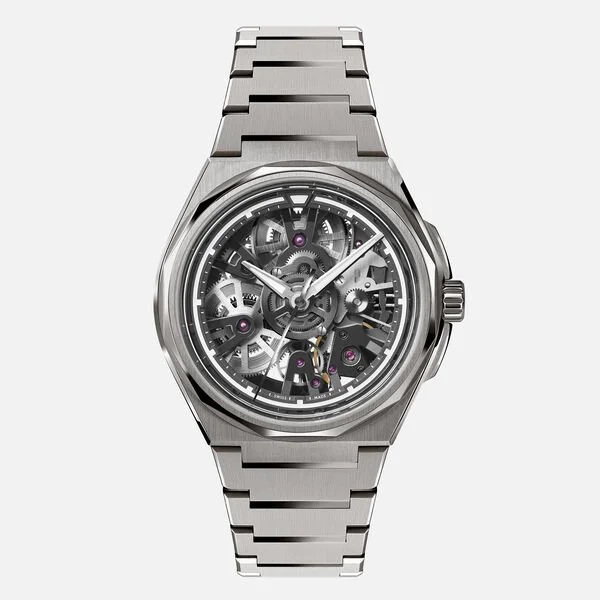
The Twelve X (Ti) is the point where CW’s integrated‑sports design meets the brand’s most serious movement work. Built around the skeletonised, chronometer‑rated SH21, it was created to mark both ten years of the in‑house movement and CW’s twentieth anniversary as a brand.
The result feels purposeful but surprisingly calm: the twin barrels, bridges and gear train are visible from both sides, but the layout is ordered, not chaotic. The titanium construction plays a big role in how it wears. The mix of Grade 2 and Grade 5 keeps the 41mm case and bracelet light on the wrist, while the finishing – a blend of hand‑polished facets and sharp machine‑cut surfaces – gives it a crisp, modern feel.
It’s an integrated sports watch, but one with a bit more refinement and far more movement on display than most.
Twelve X is positioned at the top of the range for a reason: it’s where the brand brings together its movement work, its finishing, and its design language in one piece. It fits naturally within the Atelier mindset – not because it’s complicated for the sake of it, but because it shows CW using SH21 in a more expressive, architectural way, while still keeping the watch wearable every day.


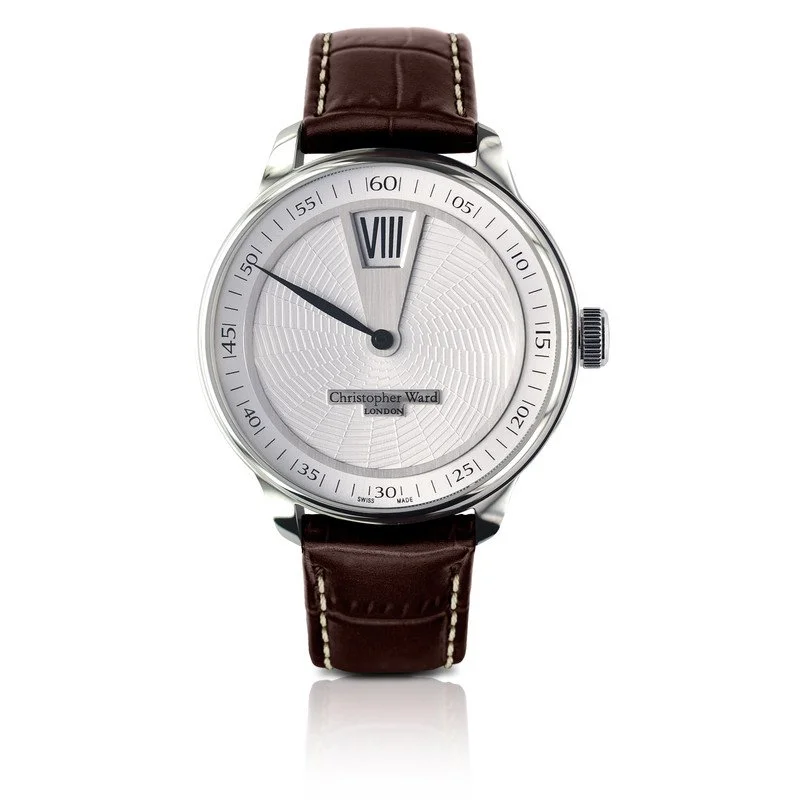
“My second CW was a Jumping hour — and it genuinely inspired me. That crisp ‘snap’ at the top of the hour never gets old; it’s a little moment of magic that made me fall head‑over‑heels for mechanical watches”
SH21 stands for “Synergies Horlogères” (SH) and the 21st movement project developed inside that Biel‑based workshop.
Synergies Horlogères was CW’s Swiss technical partner at the time, run by Jörg Bader Snr, and it later became fully integrated into CW as the Christopher Ward Atelier. SH21 was the team’s biggest achievement – their 21st project, but their first fully in‑house calibre designed for CW.
“Apex was developed with Armin Strom — the independent Swiss atelier famous for open‑worked movement architecture.
Their collaboration turned SH21 into something special: a modern, sculptural piece of horology that showed CW was ready to stand alongside serious watchmakers.”
“If the Apex was CW opening the door to SH21, the Concept is CW letting you wander around the room and see the movement from angles you never normally get.”
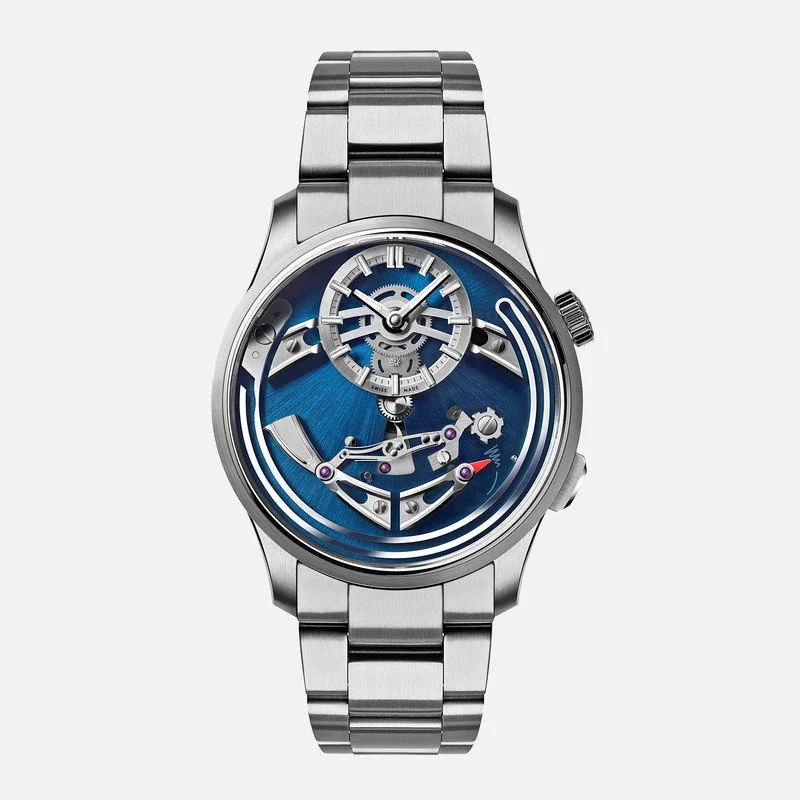
“Bel Canto received major industry acclaim, including winning the GPHG ‘Challenge’ Prize — one of the most respected awards in modern watchmaking. It was recognised across the industry as one of the standout releases of its year.”
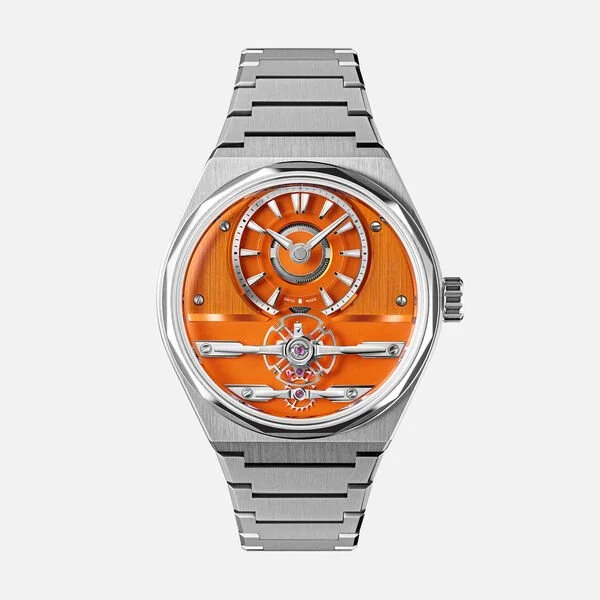
“Loco works because CW didn’t try to repeat Bel Canto. Instead, it took the idea of ‘let’s show people what makes this watch interesting’ and built something with its own character.”
3) Dive
Dive watches are where Christopher Ward really cut its teeth. Long before in‑house movements, chiming complications or integrated sports watches, it was the dive category that allowed CW to test ideas, push specifications and gradually refine its design language. Whilst it is not difficult to see CW’s inspiration, these watches were never about borrowed heritage; they were about building something solid, wearable and genuinely capable at a much lower price point.
There have been other dive models along the way, but the C60 Trident has been a stalwart of the brand’s development and journey. Across multiple generations it evolved from a promising newcomer into one of the most capable dive watches at its price point and, in doing so, became central to CW’s identity. To understand how the modern Trident Pro 300 came to be, it’s worth starting at the beginning.
3.1 Early foundations: Kingfisher (2007–2010)
Christopher Ward’s dive‑watch story begins in 2007 with the quartz C6 Kingfisher, followed shortly by a realm of automatic variants. These early watches were straightforward and functional, with aluminium bezels, bold dial colours and dependable Swiss movements. The design language was still forming, but the priorities were clear: usability, legibility and strong specifications for the money.
The Kingfisher feels transitional in hindsight, but it laid the groundwork for everything that followed.
3.2 The turning point: C60 Trident Mk1 (2009–2012)
Introduced in 2009, the C60 Trident Mk1 marked the point at which CW found a clear dive‑watch identity. Compared to earlier models, the Trident brought cleaner dial layouts, better hand and marker proportions and a case that balanced tool‑watch intent with everyday wearability. It also introduced CW’s signature second hand with a trident as a counterpoint.
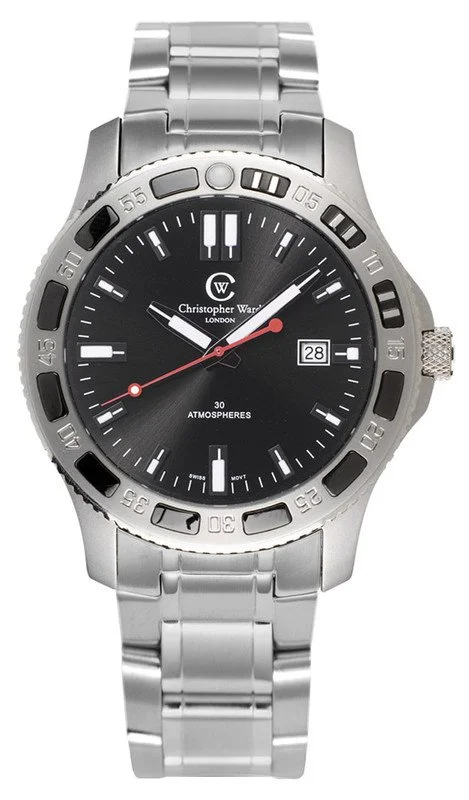
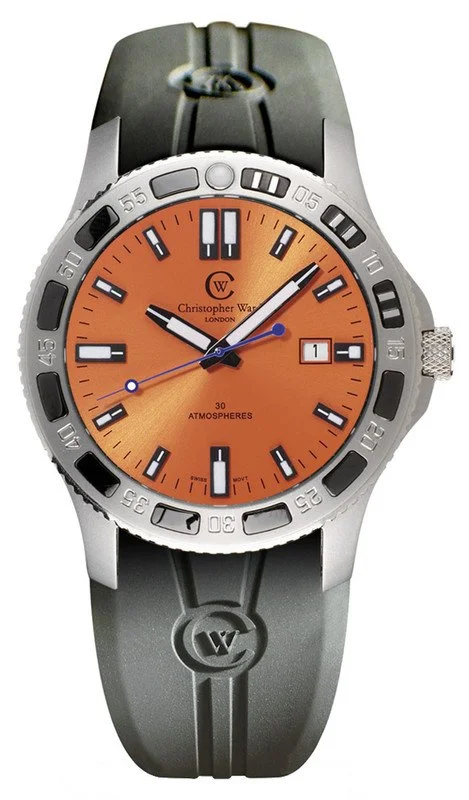
Early Mk1 models featured the round Christopher Ward London logo and were available only in black, with painted aluminium bezel inserts. Although the handbook stated a 42mm case, the watch actually measured 43mm. In 2010, GMT versions were added, identifiable by white or orange bezel pips. By 2012, the Trident range expanded significantly, with the introduction of the Chr. Ward logo and a broader palette of bezel and accent colours, some of which have since become very collectable.
3.3 The Makaira era: C11 Pro 500 (2011–2015)
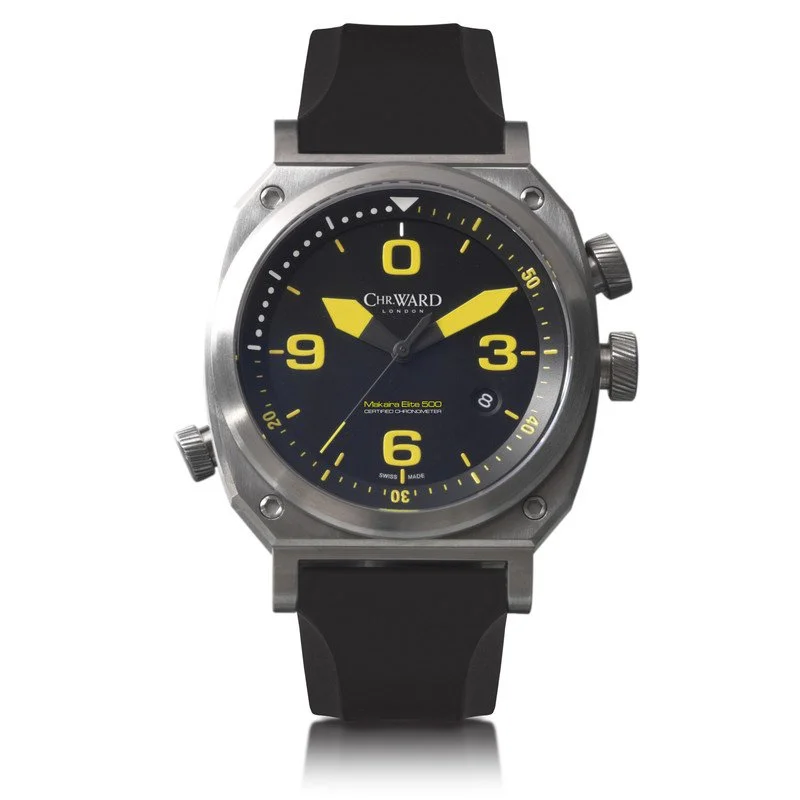
Launched in 2011, the C11 Makaira Pro 500 represented CW’s most uncompromising dive watch. Chunky, angular and unapologetically over‑engineered, the Makaira pushed water resistance to 500 metres and prioritised robustness and legibility over refinement. It was a deliberate exploration of the extreme end of the tool‑watch spectrum.
The standard Pro 500 arrived in August 2012 in three non‑limited colours, but it was the later variants that defined the Makaira’s reputation. The Titanium Elite followed in November 2012: a 500‑piece COSC‑certified model with yellow markers that sold out within a year and remains the most desirable mainstream Makaira. In 2014, CW doubled down with the Makaira Extreme - 1,000 pieces, 1,000m water resistance and a substantial titanium case that divided opinion on the wrist. Production ended in 2015.
3.4 Growing up: Trident Mk2 and Pro 600 (2013–2018)
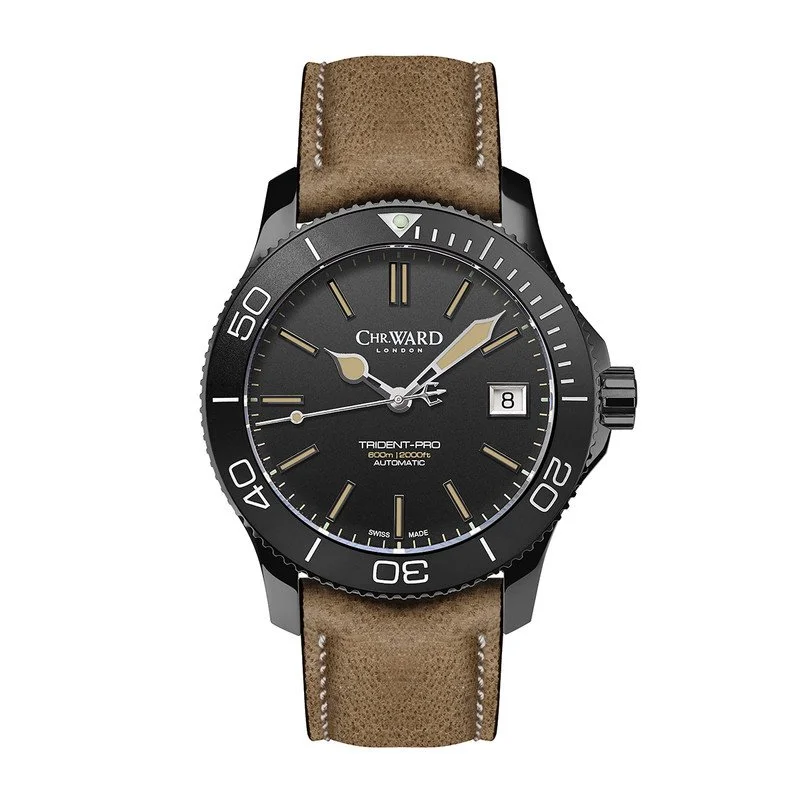
The C60 Trident Mk2, introduced in 2013, refined rather than reinvented the Mk1. Aluminium bezels were replaced by ceramic, dial markers changed from pips to batons, crowns became larger, and water resistance doubled from 300m to 600m, creating the Trident Pro 600. Bracelets gained the brilliant ratchet (no-tool) micro‑adjustment and the automatic range expanded significantly in size and colour.
Alongside the automatic models, CW introduced a quartz C60 Trident 300 using the earlier Mk1 case architecture. These steel‑only quartz models ran in parallel with the automatics and remained in production until late 2019, with final stock sold in early 2020, after which CW moved the Trident line to automatic‑only.
Titanium automatic Tridents arrived in 2016, followed by CW’s new 9‑o’clock wordmark logo later that year. Transitional “Mk2.5” models appeared around 2017, simplifying the range, introducing bronze cases, and finally acknowledging the true 43mm case size in official documentation.
3.5 Coming of age: Trident Pro 600 Mk3 (2019–2023)
Launched in 2019, the Trident Mk3 marked the point at which Christopher Ward’s dive watches truly came of age. Rather than pushing depth ratings or overt tool‑watch cues, CW focused on refinement: how the watch wore, how cohesive it felt, and how comfortably it could live on the wrist day to day.
The new Light‑Catcher case brought cleaner transitions between surfaces and a more contemporary profile, reducing visual bulk without losing the Trident’s purposeful character. At the same time, the dial and handset were simplified. The heavier, more distinctive Mk2 hands were retired in favour of a cleaner, more modern design that better suited the Mk3’s calmer aesthetic. The long‑standing top bezel lume pip — a known weak point on earlier generations — was removed entirely.
Bracelets were redesigned to suit the new case, gaining improved articulation and quick‑release spring bars, and case sizes were rationalised to 38mm, 40mm and 42mm, finally drawing a line under the long‑running 43mm format.
3.6 Refinement: Trident Mk3 Pro 300: (2021–date)
Appearing hot on the heels of the Pro 600, the Trident Pro 300 marked a subtle but important change in direction. While it represented a step backwards on paper in terms of water resistance, it was a deliberate move rather than a compromise. Outside of bragging rights, few owners ever needed 600 metres, and dropping back to 300m allowed CW to focus on what actually mattered day to day.
The Pro 300 introduced a slimmer case profile, improving comfort and wearability, and moved the date to 6 o’clock, giving the dial a cleaner, more balanced look. These small but thoughtful changes helped the watch feel calmer and more resolved, without losing the core Trident character.
In practice, the Pro 300 proved to be the better everyday diver. More wearable, more versatile and still more capable than almost any real‑world use demands, it became the natural centre of the Trident range. With the later discontinuation of the Pro 600, the Pro 300 now stands as the definitive modern Trident — not because it does the most, but because it does exactly what it needs to.
3.7 The little brother: the C65 dive range (2018-date)
The C65 dive range began in earnest in 2018 with the launch of the C65 Trident Diver Vintage. While earlier, larger C65‑named watches existed, it was this model that properly established the C65 as we now understand it — slimmer, calmer, and deliberately retro in character. Earlier 43mm C65 models existed before this point, but they belong to a more transitional chapter in CW’s catalogue and are better understood outside the modern C65 dive story.
Importantly, the C65 Diver Vintage also marked the first proper application of CW’s Light‑Catcher case design to the C65 dive line. The Light‑Catcher philosophy itself dates back to 2014, where it was first explored on dress watches such as the C1 Grand Malvern, but the C65 was the point at which that sculpted, wrist‑hugging case architecture was successfully translated into a slim, vintage‑inspired dive watch.
From the outset, the C65 was positioned as the Trident’s little brother. Not lesser in quality or intent, but different in emphasis. Case profiles were slimmer, crystals domed, dial layouts simpler and more symmetrical. Water resistance was still perfectly adequate for real‑world use, but no longer the headline. Instead, the focus shifted to proportions, balance and how the watch felt on the wrist over a full day’s wear.
As the range developed, the C65 family expanded in several directions including the Aquitaine most recently. Classic three‑hand divers sat alongside GMT variants, while some models blurred the line between dive and field watch. Despite this variety, the core character remained consistent: the C65 was always the more relaxed, understated alternative to the Trident — a watch for those who liked the idea of a dive watch, but not necessarily the visual weight of a modern professional diver.
My own favourite member of the family is the C65 Super Compressor. A genuine super‑compressor design, it revives an ingenious mid‑century system in which increasing water pressure improves the watch’s sealing as depth increases. In practical terms, this mechanism is largely redundant given modern gasket technology - but that rather misses the point. It’s mechanically unnecessary and utterly brilliant at the same time.
Uniquely, the C65 Super Compressor also chooses to show its workings. An exhibition caseback — a first for a true super‑compressor — reveals the compression spring and diving‑bell motif, turning a normally hidden functional element into part of the watch’s appeal. Combined with its internal rotating bezel, sunburst dial and slim case, it feels like a mid‑century professional diving instrument reimagined for modern enthusiasts.
Taken as a whole, the C65 range complements the Trident rather than competing with it. Where the C60 Trident is CW’s core diver, the C65 Trident is its thoughtful counterpoint, bringing vintage inspired pieces bang up to date.

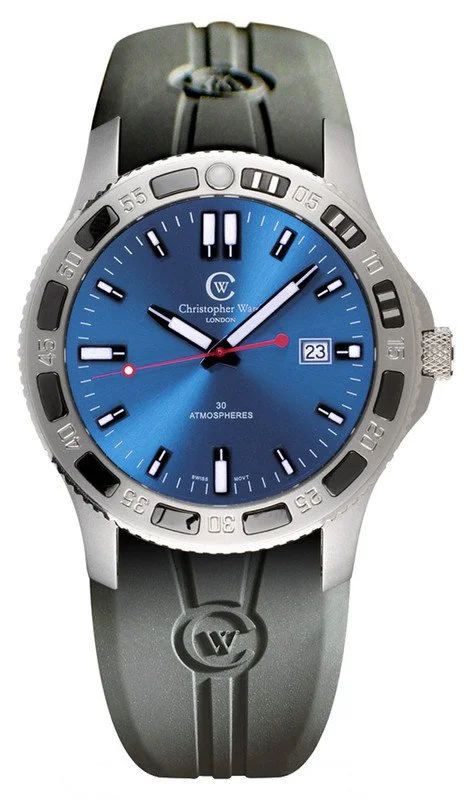
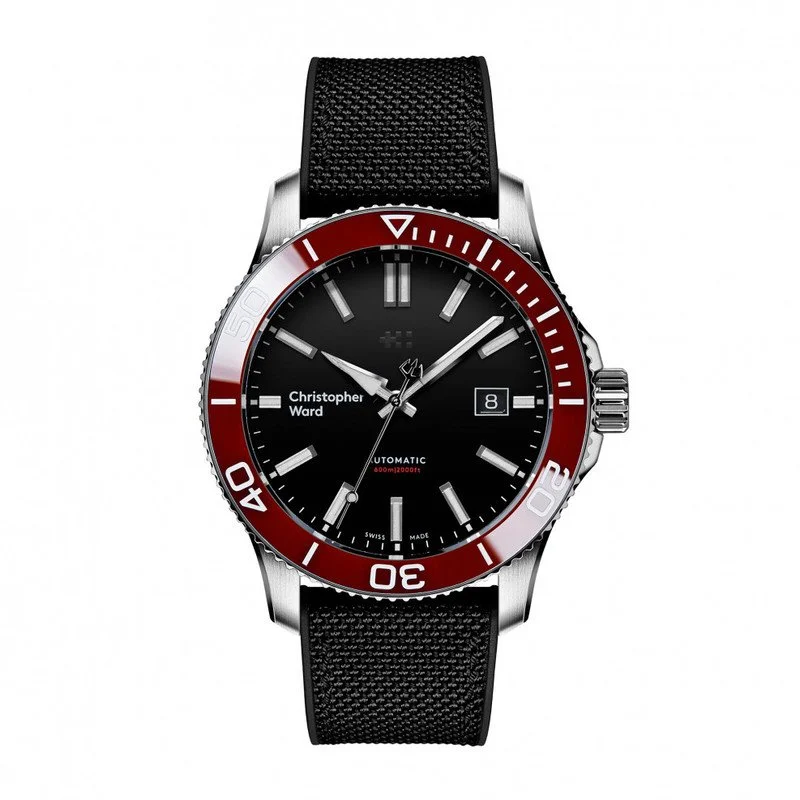
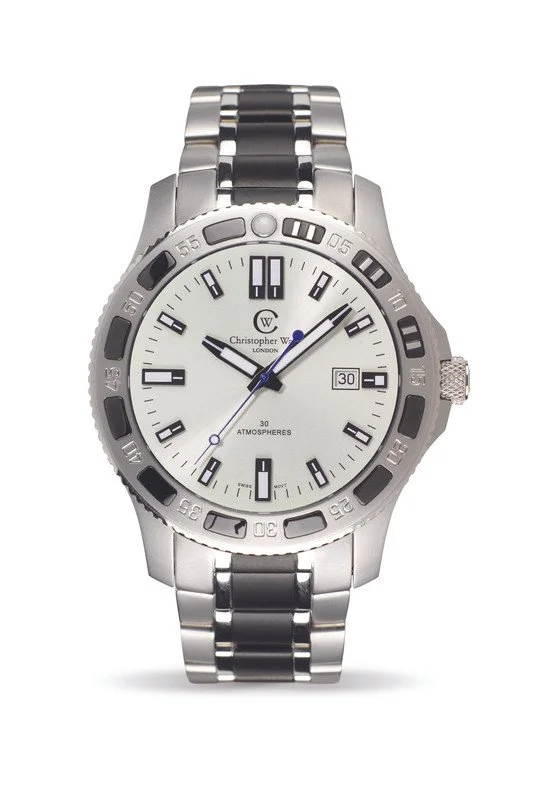
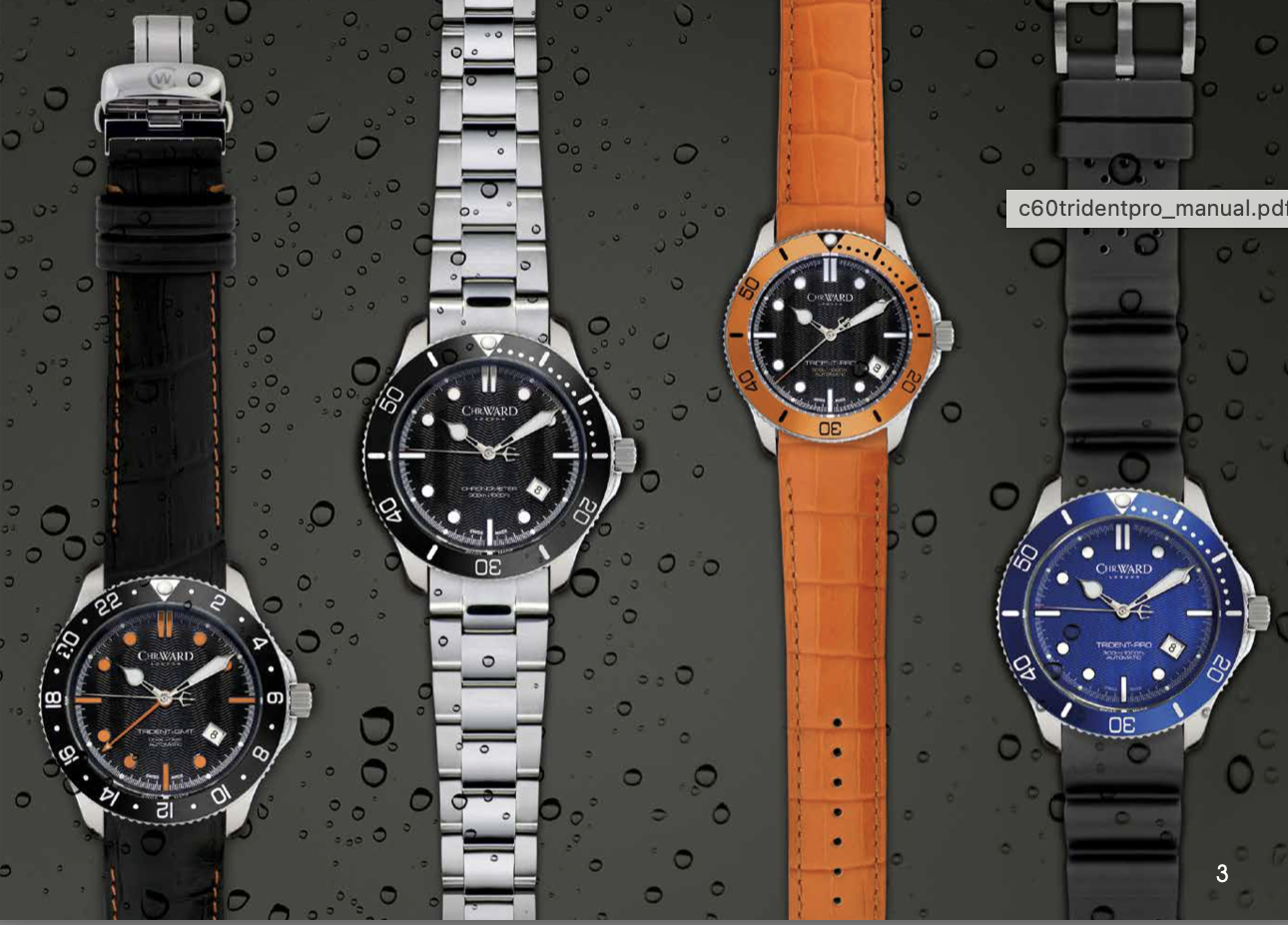
“The Makaira is perhaps the most sought after CW dive watch on the secondary market.”
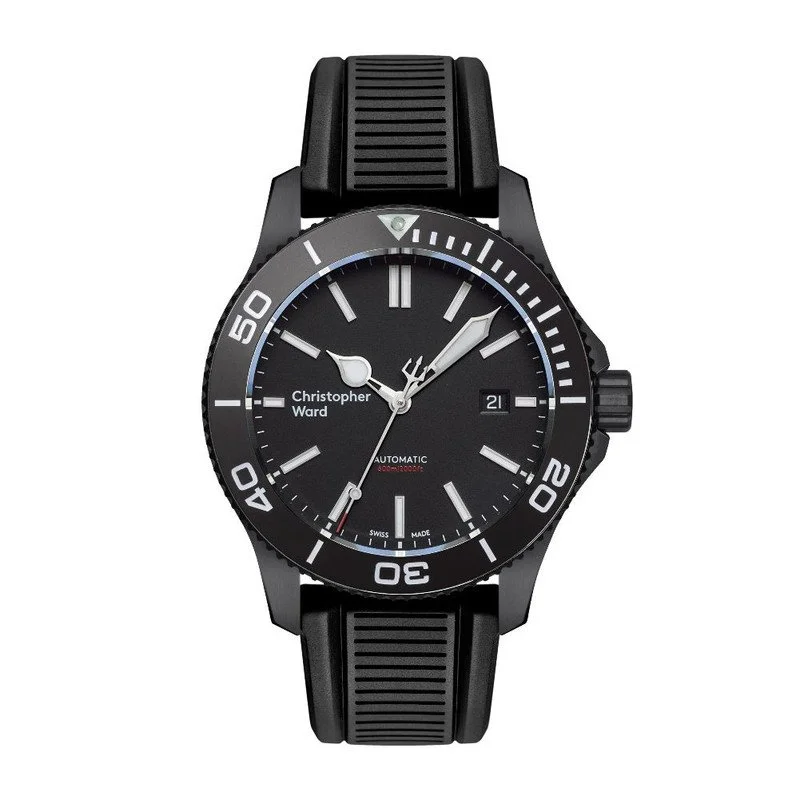
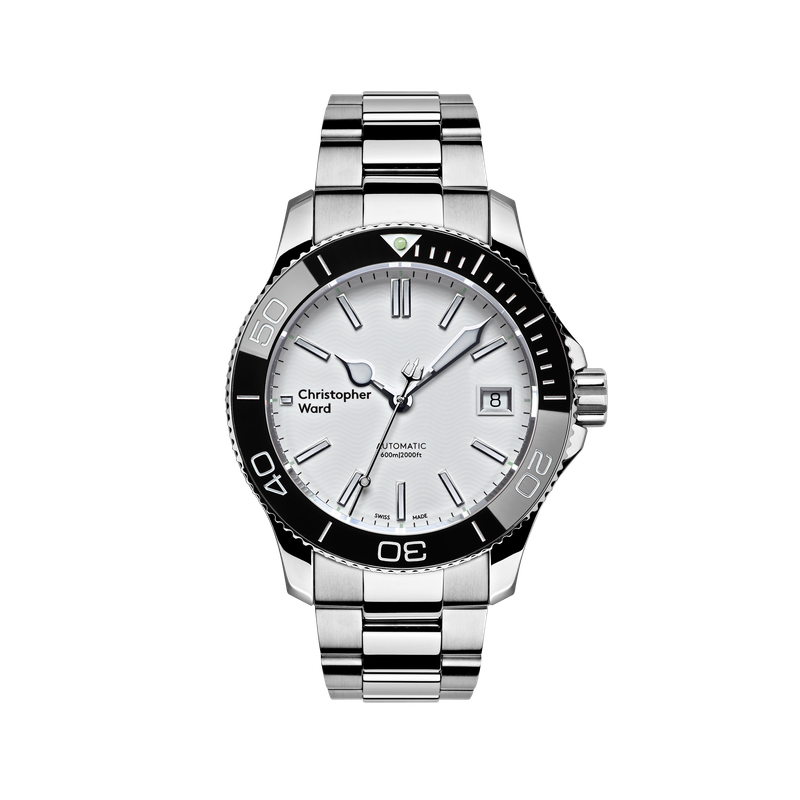
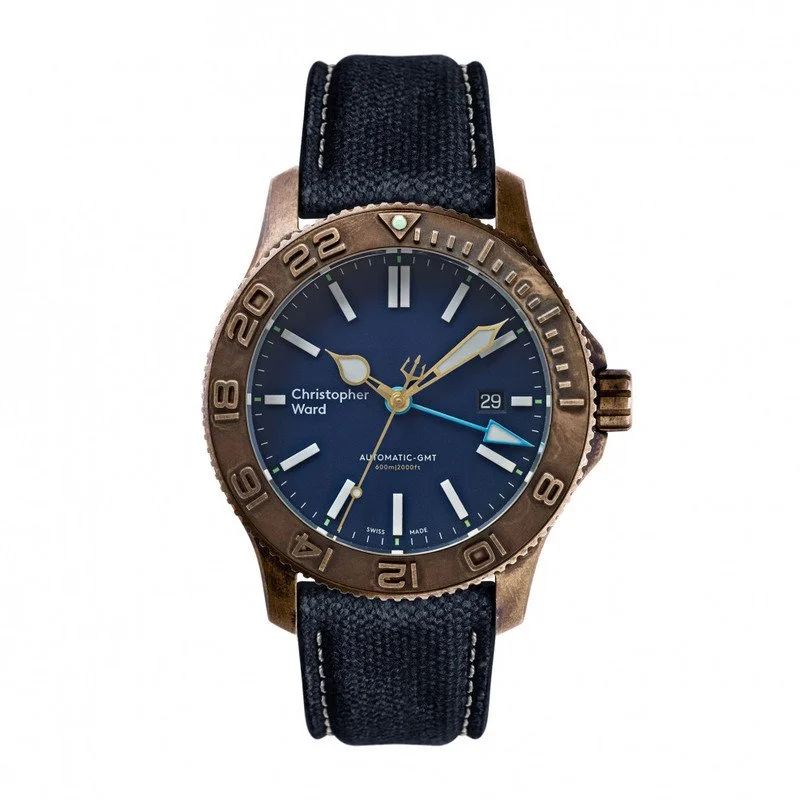
“The Mk3 Pro 600 was the last Trident to carry a red bezel due to reported problems with production cost.”
4) Aviation
Christopher Ward has a long and often overlooked history of producing aviation‑inspired watches, stretching back almost to the brand’s earliest years. Unlike the dive range — which steadily evolved into a clear flagship — CW’s pilot watches have followed a more exploratory path, with bold case designs, unconventional complications and a willingness to experiment that has occasionally produced cult classics.
That story begins not with a purpose‑built pilot watch, but with a familiar name.
At the time of writing, Christopher Ward no longer offers a dedicated aviation watch. The closest equivalents now sit within the military‑inspired collections, but the C8, once such a distinctive pillar of the catalogue, is absent.
Whether that absence is temporary or permanent remains to be seen. Given CW’s history, it would be unwise to bet against a return.
4.1 Early steps: C5 Malvern Aviator (2006)
CW’s first aviation‑leaning watch arrived in 2006 with the C5 Malvern Aviator, itself derived from the brand’s very first watch, the C5 Malvern. This was a gentle introduction rather than a statement piece - aviation‑inspired rather than aviation‑specific - but it represented the first baby step on a genre of pilot watches that would form a meaningful part of CW’s catalogue.
4.2 The C8 case arrives: Pilot Mk1 and Mk2 (2008–2015)
The real turning point came in 2008 with the introduction of the C8 Pilot Mk1 and, crucially, the C8 case. At 44mm, it was the largest case diameter CW has ever produced. On paper that sounds enormous, but the reality has always been more nuanced. Still too large for me (and my relatively modest sized wrists), but thanks to its relatively slim profile (just 9.7mm thick for the Mk2), the C8 has never worn like CW’s biggest watch. In fact, a 15mm‑thick 42mm C60 feels considerably larger on the wrist than a 9.7mm‑thick 44mm C8.
The C8 Pilot Mk2, released in 2010, refined the concept and proved long‑lived. At launch, it cost just £335, rising to around £500 for a PVD version by the time production ended in 2015. Put into context, the C60 cost around £300 in 2009, so the C8 didn’t feel like a bargain at the time — even if those prices sound faintly absurd today.
4.3 Brief detours and curiosities: C80 Sector (2009)
The C80 Sector is an extremely rare and short‑lived model introduced in August 2009. It was inspired by the distinctive Sector clocks used during the Second World War to plot and time enemy aircraft movements, and it stands as one of the more unusual detours in CW’s aviation catalogue.
The C80 was originally offered in US and Great Britain variants. Production was brief and the model disappeared quietly from the catalogue soon after launch, reportedly amid concerns over intellectual‑property issues, the exact details of which have since faded into forum lore.
Today, the C80 Sector is rarely seen and largely unknown outside dedicated CW circles, but it remains a fascinating snapshot of a period when the brand was still willing to experiment freely with design, theme and historical reference.
4.4 Laser focus: C8 Flyer (2015-2019)
The C8 Flyer was introduced in August 2015 in both 38mm and 44mm case sizes, with automatic and quartz options available. It was CW’s most focused aviation watch to date, taking direct inspiration from the Smiths cockpit clock fitted to the Supermarine Spitfire, and prioritising legibility and functionality over novelty.
The original Flyer established a clear design brief: a clean, highly readable dial, an oversized crown, and a purposeful aviation aesthetic rooted in instrumentation rather than decoration. Despite its large diameter, the C8 case’s inherently slim profile meant the Flyer wore more comfortably than the numbers suggested, particularly in the 38mm version.
In August 2017, the Flyer was reintroduced as the C8 Flyer Mk2. This update brought new steel and DLC case options and a revised dial with sharper detailing, but it also marked an important shift in the range. The 38mm size was dropped, leaving the Flyer as a 44mm‑only proposition. While the Mk2 remained true to the original concept, the loss of the smaller case subtly changed the watch’s character, pushing it further toward a statement pilot’s watch rather than a broadly wearable everyday option.
The C8 Flyer Mk2 was retired in March 2019, bringing an end to CW’s most coherent aviation watch line. With it went the last modern expression of the C8 as a contemporary pilot’s watch rather than a retrospective or commemorative piece.
4.5 Complications and cult status: C8 Regulator, C1000 Typhoon, C8 P7350, Power Reserve and UTC (2013–2016)
In 2013, CW introduced the C8 Regulator, and in doing so created an instant cult classic. Powered by a modified Unitas 6498, it displayed minutes on the main hand, hours on an upper sub‑dial and seconds on a lower sub‑dial — a layout that felt both unconventional and perfectly suited to aviation timing.
That same year also saw the launch of the C1000 Typhoon, one of the most technically ambitious watches CW has ever produced. Inspired by the Eurofighter Typhoon, it featured a titanium inner frame wrapped in a carbon‑based ceramic outer case — the first and only time CW has used such an advanced composite construction. Exceptionally light, highly scratch‑resistant and correspondingly expensive, it was a bold departure from CW’s usual value‑led formula. The experiment was never repeated and the Typhoon remains a genuine outlier in the catalogue.
The C8 case then served as the basis for a number of increasingly ambitious releases. 2015 saw the C8 P7350 and in 2016 CW arguably hit peak form with the C8 Power Reserve and the C8 UTC Worldtimer. For many collectors, these represent the high‑water mark of CW’s aviation output: technically interesting, visually distinctive, and still very wearable despite their size.
4.6 Special editions and Concorde: hits and misses (2018–2019)
In 2018, CW released the Al Deere and Birkin’s Blower editions. Both featured special SH21 movements and elaborate caseback artwork executed with TMB Art Metal sourced from ConcordeG-BOAB. While technically impressive, they were expensive for what they were and never quite caught fire in the way CW may have hoped.
That changed in 2019 with the release of the M2.04 Concorde Edition, which finally brought together case design, subject matter and execution in a way that felt genuinely special. It remains one of the most successful and best‑regarded aviation watches CW has ever produced.
4.7 Looking back: the C8 Revival (2022)
Most recently, in 2022, CW released the C8 Revival models. These were notable for being the first C8s to feature a full‑size exhibition caseback, a genuinely nice touch, but they also felt like what they were: a modern re‑issue built around unused historical cases.
Traditionally, such releases have represented excellent value, but this time CW priced them strongly. As a result, the 200 silver‑case pieces sold slowly, while the 50 PVD black versions disappeared within days and are now the more desirable of the two.
5) Motor sport
With a few notable exceptions, the Christopher Ward C7 and C70 ranges have always been home to the brand’s sport and motorsport‑inspired watches. Unlike the dive collection, which evolved steadily into a clear flagship, CW’s motorsport watches arrived in defined phases, often tied to specific events, circuits or eras of racing history.
5.1 Foundations: the C70 Grand Prix range (2007–2012)
The C70 is one of the most important and, today, most collectable motorsport watches Christopher Ward has ever produced. More than any other line, it established CW’s early reputation for bold design, historical storytelling and disruptive value.
The range began in 2007 with the launch of the C70 Grand Prix series. Originally, the collection consisted of six models, each dedicated to a landmark early Grand Prix race and host nation, celebrating the formative years of international motorsport when precision timing was paramount. These original six were produced as 500‑piece limited editions, powered by ETA quartz chronograph movements and remain the purest expression of the C70 concept.
The original Grand Prix models were:
France GP (1906)
Italy GP (1921)
USA GP (1923)
Belgium GP (1925)
Great Britain GP (1926 – Brooklands)
Germany GP (1931 – Silver Arrow)
As the range gained traction, CW expanded the C70 beyond its original Grand Prix brief. In 2011, the C70 Monte Carlo was introduced to mark 100 years of the Monte Carlo Rally, becoming the seventh C70 motorsport watch overall and the first to step outside pure Grand Prix racing into rallying. It also marked an important design evolution: unlike the earlier models, which used engraved steel casebacks, the Monte Carlo introduced a coloured inlay featuring the rally’s grille badge.
That design decision proved influential. From this point on, the C70 evolved into a broader platform rather than a tightly defined series. It spawned Grand Prix COSC variants with ceramic or enamel flag inlays, RAF and “Per Ardua Ad Astra” editions, and a number of British motorsport‑focused specials, including DBR1‑inspired models celebrating Aston Martin’s racing heritage.
By the mid‑2010s, the C70 family had grown into the low twenties in terms of variants, covering Grand Prix racing, rallying, aviation‑linked military themes and British motorsport mythology. Some purists argue this diluted the original concept, but it undeniably cemented the C70 as a cornerstone of CW’s catalogue.
Today, the C70 range is highly collectable. Limited production numbers, strong historical narratives and distinctive design mean many models are increasingly sought after on the secondary market — particularly the original Grand Prix pieces and early specials. As a chapter in CW’s history, the C70 stands not just as a motorsport watch, but as the moment the brand proved it could build a cult following well beyond dive watches.
5.2 The C7 line: Mk1 & Mk2 (2008–2017)
The C7 Rapide Mk1 arrived in 2008 as a quartz chronograph, establishing the C7 as a contemporary motorsport line built around legibility and function rather than narrative storytelling (as the C70 predecessor). It was bold, modern and very much of its time, with a conventional monobloc case and classic chronograph proportions.
That approach continued with the Mk2, introduced in 2012. In reality, this was an evolution rather than a reinvention: the Mk1 case architecture was retained, while dial layouts, hands and movements were revised. The underlying proposition remained unchanged — accessible, reliable motorsport timing powered by battery movements. Mk2 models ran until 2017 (including a number of limited edition runs), by which point the C7 was well‑established but also clearly constrained by its original design brief. It remains one of the most accessible entry points into CW watches
5.3 The C7 Rapide Mk3: split‑case reinvention (2017–2019 )
In 2017, the C7 underwent a genuine transformation. With the arrival of what is now informally known as the Mk3, the C7 Rapide received a complete redesign, and for the first time automatic movements became available within the C7 range. Although Christopher Ward never officially adopted the Mk3 designation, the generational shift is unambiguous.
Beyond the name and its 42mm diameter, the Mk3 shared very little with its predecessors. The defining feature was its multi‑part, split‑case construction, with a distinct central case band separating the bezel and caseback, often executed in contrasting finishes or colours. Hollowed‑out lugs added further visual depth and gave the watch a far more architectural presence on the wrist.
This was not a cost‑neutral exercise. The complexity of the case made the Mk3 significantly more expensive to manufacture, and visually it stood apart from anything else CW had produced before or since. Combined with applied indices, textured dials and improved finishing, the Mk3 finally gave the C7 a strong and confident identity of its own.
For many enthusiasts, this is where the C7 truly came into its own. That it was quietly discontinued remains one of the more regrettable decisions in CW’s recent motorsport history.
5.4 Peak ambition: C7 Apex (2018)
The C7 Apex, released in 2018, was never intended to be a mainstream evolution of the C7 line. Instead, it was a deliberate statement piece, created to mark five years since the first working prototype of CW’s in‑house SH21 movement. Everything about the Apex reflects that brief: a four‑part case, extensive DLC finishing, and a semi‑open dial that puts the movement front and centre. The motorsport influence remains, but in abstract form — closer to a concept car than a production racer.
One of its most distinctive details is the red power‑reserve indicator, which reads visually like a brake caliper cutting across the dial.
Powered by a hand‑wound, COSC‑certified SH21 with a five‑day power reserve, and limited to just 50 pieces, the Apex was one of the most expensive watches CW had ever produced at the time. It sold out quickly, but it was never meant to lead to a new generation.
5.5 A parallel path: the C90 Becketts and the C9 AM GT (2010–2019)
Running alongside the chronograph‑led C70 and C7 ranges was a quieter but more mechanically expressive strand of CW’s motorsport output. Rather than timing laps, these watches focused on automotive design language, power‑reserve displays and proportion — motorsport inspiration filtered through refinement rather than outright sportiness.
In 2010 with the watch originally known as the C90 Becketts was introduced. Initially slated to be number four in the C9 series, it quickly developed an identity of its own when CW created it to celebrate the announcement that Silverstone had secured the British Formula One Grand Prix for a further 17 years. The watch struck a chord with the CW community and was voted “Watch of the Year” by the CW Forum in 2010.
Later that same year, the watch was renamed the C90 Power Reserve after CW discovered that the Beckett(s) name was protected. The change was administrative rather than conceptual, but it marked the point at which the watch was more firmly absorbed into CW’s core catalogue. With its power‑reserve complication and restrained motorsport cues, the C90 stood apart from the narrative‑heavy C70 range and the overtly sporty C7 chronographs.
Nearly a decade later, this parallel approach reached its most refined expression with the C9 AM GT, introduced in 2019 as a limited edition of 135 pieces. Built on the long‑running C9 case — originally CW’s flagship dress‑watch platform — the AM GT translated classic automotive instrumentation into a far more elegant motorsport watch. Speedometer‑inspired numerals, an inclined outer dial ring and a power‑reserve indicator styled like a rev counter gave the watch a clear motorsport identity without relying on chronograph scales or racing colours.
Mechanically powered by the ETA Valgranges A07.161, the C9 AM GT also marked the final appearance of the C9 case design in the CW catalogue. In that sense, it serves as both a culmination and a farewell: the last motorsport watch to take a more dress‑leaning, mechanically expressive route, rather than the bold, technical language of the C7 or the historical storytelling of the C70.
6) Integrated sports
Christopher Ward’s integrated sports watches sit at opposite ends of a broader market cycle. The category itself, born in the 1970s, spent decades out of favour before returning forcefully in the late 2010s and early 2020s. That revival was driven by a combination of renewed interest in 1970s design and the growing interest around Gérald Genta’s work such as the Audemars Piguet Royal Oak and Patek Philippe Nautilus.
As waiting lists lengthened and access narrowed, demand spilled downward, creating space for more affordable interpretations. Brands like Tissot, with the PRX, demonstrated just how large that audience had become and many others followed.
CW’s contribution to this story came in two very different phases.
6.1 C2 and C20 Lido (2008 to 2012)
The Lido was CW’s first serious attempt at an integrated‑bracelet sports watch, introduced in the late 2000s when the category was still largely dormant. With its integrated case and bracelet, slim profile and versatile design, it clearly referenced the sport‑luxury watches of the 1970s — but it arrived well before the market rediscovered its appetite for that style.
Although sound in concept and execution, the Lido struggled to find a clear audience. It sat awkwardly between dress and sport at a time when tool watches dominated enthusiast attention, and it never developed into a long‑term platform. In retrospect, the Lido reads as a well‑judged idea released at the wrong moment: a quiet precursor rather than a trendsetter. It was quietly retired in 2012.
6.2 The Twelve: right idea, right time (2023 to date)
When The Twelve was introduced more than a decade after the Lido was retired, it was clear that Christopher Ward was no longer testing the integrated sports category, but committing to it. Inspired by the integrated sports watches of the 1970s, the initial release established the core design language: a slim, angular case, a seamlessly integrated bracelet, and the now‑distinctive 12‑sided, triple‑finished bezel that gave the watch both its name and identity.
What followed was a rapid but controlled expansion. Rather than treating The Twelve as a single model, CW allowed it to develop into a broad platform, responding directly to market demand. Case sizes were added to suit different wrists, with smaller and larger options appearing alongside the original dimensions. Materials expanded beyond stainless steel to include titanium, bringing reduced weight and a subtly different wearing experience without altering the underlying design.
Dial options multiplied as well. The Twelve was offered in a growing range of colours and textures, from restrained neutrals to more expressive finishes, allowing the same watch to read very differently depending on configuration. Despite this variety, the essential character remained consistent - a sign that the base design was strong enough to absorb change without losing coherence.
Across the range, CW maintained a consistent level of practical detailing. Later bracelets featured a micro‑adjust ‘butterfly’ clasp, reinforcing the idea that The Twelve was intended as a genuine everyday watch rather than a delicate style piece. This focus on wearability, combined with competitive pricing, helped separate The Twelve from both high‑end luxury icons and cheaper homages.
Unlike the Lido, which arrived before the market was ready, The Twelve benefited from perfect timing. The renewed popularity of integrated sports watches - driven by scarcity at the top end and the success of accessible models such as the Tissot PRX - created an audience actively looking for credible alternatives. CW did not invent that demand, but it responded to it effectively with its loyal customer base.
As a result, The Twelve has become one of the most recognisable and commercially successful designs in CW’s modern catalogue. Its success lies less in novelty than in execution: a well‑judged design, expanded thoughtfully across sizes, materials and finishes and aligned closely with what the market was already asking for.
7) Dress
Dress watches were the foundation on which Christopher Ward was built and they were disruptive from the outset. In the mid‑2000s, the idea that a young, online‑only brand could produce a Swiss‑made watch of genuine quality at those prices challenged prevailing assumptions about how the industry worked. The disruption was not stylistic, but economic: CW demonstrated that traditional dress watches no longer needed traditional retail margins to feel credible.
Over time, that initial value‑led disruption evolved into something more substantive. As with other categories, CW’s dress watches show clear, deliberate development - from cautious competence, to architectural confidence, and eventually to a recognisable design identity. The journey is slower and quieter than Dive or Motor sport, but no less real.
7.1 Foundations: Malvern and value‑led disruption (2005–2013)
The Malvern range occupies a unique place in Christopher Ward’s history. It includes the brand’s first ever watch, and for several years it effectively was the catalogue. Visually, early Malverns were conservative - round cases, clean dials, traditional layouts - but the disruption lay elsewhere. At their price point, few competitors offered comparable levels of finishing, materials and genuine Swiss manufacture.
That disruption is captured in one formative early episode, now part of CW’s own origin story. Dave Malone, a lecturer and watch expert from Tasmania, purchased a C5 Malvern Automatic after seeing a newspaper advertisement. His intention was not supportive: he planned to write a scathing review on Timezone.com, then the world’s largest watch forum. Instead, the watch arrived and overturned his expectations. The quality was far higher than anticipated, and the movement was a genuine ETA 2824‑2. Malone publicly described it as the “best value mechanical watch in the world”.
The impact was immediate. CW was suddenly propelled into the consciousness of watch enthusiasts globally, and shortly afterwards Hans van Hoogstraten founded an independent Christopher Ward forum - a wonderful, friendly community that remains active today. The specifics matter because they establish a pattern that would repeat throughout CW’s later history: scepticism, direct experience and a rapid recalibration of expectations.
As the Malvern range expanded to include manual‑wind models, automatics, COSC chronometers and modest complications, it became clear this was not a one‑off value anomaly. Capability and confidence increased steadily, even as the design language remained restrained. The Malvern did not seek to impress, but it achieved something more important: it earned trust. And in doing so, it laid the foundations for everything that followed.
7.2 Raising ambition: the C9 Harrison era (2010–2020)
The strength of the C9 lay in its breadth. Rather than existing as a single expression of “dress”, the Harrison became a platform. Early models explored classical layouts, but the range soon diversified. Variants such as the C9 Small Seconds shifted the visual balance away from conventional central seconds, introducing a quieter, more considered dial architecture that aligned CW with more traditional dress watch cues. Other models, including “Baby Blue” and its sibling “Big Blue”, demonstrated that a dress watch could carry colour and presence without tipping into sport - a deliberate broadening of what CW considered acceptable within the category.
The most important development, however, came with the integration of Calibre SH21 into the C9 line. SH21‑powered C9 models represented a clear escalation in ambition: five‑day power reserve, chronometer certification and a movement developed specifically for CW. Crucially, these watches did not rely on the movement alone to justify their existence. Case proportions were refined, finishing improved, and dial designs were simplified to allow the mechanics to speak without dominating.
Across its decade‑long lifespan, the C9 Harrison demonstrated something essential about CW’s approach to Dress. Development was not linear or cautious; it was iterative and exploratory, with different models testing how far the category could be stretched while remaining coherent. Some leaned traditional, others more contemporary, but all shared a sense of growing confidence.
By the time the C9 range was retired, CW had effectively proven that its dress watches could support genuine technical ambition, visual variety and long‑term relevance - not merely value. In retrospect, the C9 Harrison stands as the bridge between the Malvern’s value‑led disruption and the design‑led confidence that would follow.
7.3 Design identity arrives: the Light‑Catcher case (2016 to date)
By 2014, Christopher Ward had begun to recognise the limits of incremental refinement. While the Malvern and C9 ranges had established credibility and ambition, neither provided a visual identity that could be clearly owned. This prompted the development of the Light‑Catcher case concept - an architecturally led approach to case design intended to give CW a recognisable signature rather than another competent variation on established forms.
That concept reached production in 2016, when the C1 Grand Malvern became the first watch to feature the Light‑Catcher case. With its sculpted waist, flowing surfaces and contrasting finishes, the new architecture marked a decisive break from CW’s earlier, more conservative cases.
Importantly, this was not aesthetic theatre. Earlier CW dress watches had relied on relatively slab‑sided cases, which could feel visually heavy as diameters increased. The Light‑Catcher architecture addressed this directly. By sculpting the case flanks inward and introducing a pronounced waist, the design acted as a visual trick, reducing the perceived height and mass of the watch on the wrist. The result was improved balance and wearability, particularly on larger dress watches, while also introducing a sense of movement and depth that CW’s earlier designs had lacked.
From that point on, the C1 range became the natural home for CW’s more expressive dress watches and complications. Models such as the C1 Power Reserve integrated functionality as a core design element rather than an afterthought, while small seconds variants shifted visual emphasis away from the centre, reinforcing a more traditional dress‑watch language within a modern case architecture. The C1 Jumping Hour, which had previously existed within the C9 family, found a far more convincing setting in the Light‑Catcher case, where the sculptural form balanced the unconventional display.
Crucially, the C1 case did not remain confined to conventional dress watches. As explored earlier in the Atelier section, the same underlying architecture became the foundation for more ambitious and expressive pieces — most notably the Bel Canto. That continuity matters. It demonstrates that the Light‑Catcher was not merely a stylistic exercise, but a robust platform capable of supporting everything from restrained dress watches to technically and emotionally expressive complications.
Across this breadth of models, coherence was the key achievement. Despite housing power‑reserve indicators, small seconds layouts, jumping hours and later chiming mechanisms, C1 watches felt related rather than fragmented. The case architecture did the unifying work, allowing CW to develop its dress line horizontally — across functions and expressions — while maintaining a consistent identity.
In Dress, as elsewhere in the catalogue, this moment mirrors a broader pattern. Just as the Trident clarified Dive and the C8 refined Aviation, the C1 Light‑Catcher platform marked the point at which CW’s dress watches moved decisively from development to identity. The shift was subtle, but it fundamentally changed what the category could support.
8) Adventure
For a long time, the everyday sports watch was a notable omission from Christopher Ward’s catalogue. Dive watches were well covered, dress watches increasingly ambitious, and specialist lines such as motorsport and aviation had clear identities. But the obvious middle ground — a versatile, time‑only sports watch that could move effortlessly between settings — simply wasn’t there.
When CW finally addressed that gap, it did so decisively. This was not a tentative experiment or a soft launch, but a clear statement of intent: a new pillar for the catalogue, built to stand alongside the brand’s strongest lines.
8.1 Sealander: scale, confidence and culmination
The Sealander marked Christopher Ward’s emphatic entry into the everyday sports category. From the outset, the design was exceptionally well judged: balanced proportions, excellent legibility, and a level of finishing that made clear this was intended as a core line, not a peripheral addition. It was never a homage, nor did it rely on borrowed visual language to justify its existence.
My only initial reservation, slight but unavoidable, lay in the name. “Sealander” occupied the same semantic territory as Omega’s Aqua Terra (water and land), not by imitation but by translation. This overlap was never a flaw, merely an unnecessary association for a watch already strong enough to stand on its own. Importantly, it did not define the Sealander for long.
What followed was a confident expansion. The Sealander range grew quickly and convincingly, with multiple case sizes and numerous colours introduced to broaden its appeal and establish it as a genuinely versatile platform. Rather than diluting the design, this scaling reinforced its coherence and helped the watch embed itself as a familiar, dependable presence in the catalogue.
Alongside these sat the Sealander Elite, which refined the concept further through detail rather than reinvention. Its retractable crown was a particularly telling feature — a functional, thoughtful solution that reinforced the Sealander’s everyday credentials while signalling a more premium intent. By this point, any early naming unease had long since faded. The Sealander had established itself fully, on its own terms, through substance rather than framing.
That trajectory ultimately culminated at the top end with two key statements. The SH21 Blue Marine and Snow Leopard brought CW’s in‑house movement into the everyday sports category, elevating the Sealander beyond its original brief without altering its essential character.
8.2 Dune: texture and terrain
Running parallel to the Sealander, the Dune explored the everyday sports category from a different direction. Where the Sealander emphasised balance and neutrality, the Dune leaned into texture, tactility and environment, drawing subtly on field‑watch cues rather than polished sports references.
The defining moment for the Dune came with the introduction of the Aeolian dial. Its finely grained surface gave the watch a strong material identity, adding depth and atmosphere without compromising clarity or restraint. This was not decoration for its own sake, but a deliberate shift in emphasis — away from polish and toward terrain.
As with the Sealander, the Dune expanded across sizes, reinforcing its role as a fully fledged line rather than a stylistic offshoot. Its case finishing, muted colour palette and dial treatments gave it a sense of purpose distinct from the Sealander, even though both answered the same everyday brief.
The result is a watch that stands comfortably alone. The Dune does not refine the Sealander’s idea so much as restate it, proving that CW’s long‑absent everyday sports category could support more than one convincing interpretation — each confident, resolved, and clearly intentional.
9) Military
Christopher Ward’s military watches fall into two distinct categories. First are the open‑series models, produced for the general public but formally licensed and shaped by service institutions and history. Alongside these sit bespoke commissions, created directly for military organisations and units, typically in small numbers and outside the commercial catalogue.
The distinction is important. Open‑series watches balance accessibility with authenticity; bespoke pieces exist solely to meet the requirements of the commissioning service. CW has operated in both spaces for more than a decade, and each has informed the other.
9.1 Open‑series military watches
The earliest expressions of CW’s military interest were the C4 Battle of Britain and C5 Battle of Britain, released as limited editions in the late 2000s and 2010 respectively. These watches were explicit tributes to RAF history, incorporating sober dial layouts and the 6B/159 RAF stores reference engraved on the caseback.
The C5 Battle of Britain in particular stands out. Based on the original Malvern platform, it combined modest proportions with clear aviation‑watch cues and remains one of the most convincing early expressions of CW’s military design language. It is still one of my personal favourites from the brand’s catalogue. In hindsight, both the C4 and C5 can be seen as proving grounds, establishing credibility before CW committed more fully to the category.
A defining moment came in 2019, when Christopher Ward was licensed by the UK’s Ministry of Defence to produce watches for the general public bearing the insignia of the Royal Navy, British Army and Royal Air Force. The initial launch comprised three models — one for each Service — and marked the formal beginning of CW’s structured Military Collection.
Those first releases were:
C65 Sandhurst (Army)
C65 Cranwell (RAF)
C65 Dartmouth (Royal Navy)
All three were built on the C65 platform and shared a common approach: restrained military typography, chronometer‑certified movements, practical case sizes and disciplined dial layouts. Each referenced its service heritage without attempting to replicate issued equipment.
The range was expanded in 2020 in two directions. A black‑dial Dartmouth broadened the naval offering, while the C60 Lympstone introduced a more overtly modern and rugged expression of military design. Named after the Royal Marines’ Commando Training Centre, the Lympstone combined 600‑metre water resistance, forged‑carbon elements and an internal compass bezel, showing that the collection could move beyond vintage interpretation without losing coherence.
Further development followed in 2021, including the addition of the Colchester, developed in conjunction with the Parachute Regiment, reinforcing the sense that the Military Collection was becoming a sustained and evolving part of the catalogue rather than a symbolic gesture.
In 2022, the collection was refreshed with Series 2 versions of the Sandhurst, Cranwell and Dartmouth. These updates refined case proportions, improved finishing and legibility, and replaced overt branding with CW’s twin‑flags emblem, aligning more closely with historical military practice.
The most recent expansion came in 2024 with the introduction of the C63 Valour. Formally approved by the Ministry of Defence and dedicated to all three Services, it brought a chronograph into the open‑series military line. Its compact case and high‑accuracy thermo‑compensated quartz movement reflected modern military priorities of precision and reliability rather than mechanical sentiment.
9.2 Bespoke commissions
Running alongside the public Military Collection has been a quieter but historically significant strand: bespoke watches commissioned directly for military organisations.
The first of these was the Submariner Trident Mk1, released in September 2014. Based on the C60 Trident and designed for the Royal Navy Submarine Service, it was produced as a 60‑piece bespoke edition. Notably, the project was initiated by CW Forum member “gregstar” (not me!), highlighting the role of the enthusiast community in shaping CW’s early military work.
That commission established the template for what followed. These watches were not conceived as retail products nor intended for public sale. Instead, they were designed to meet the needs of a specific unit with custom markings, functional priorities and minimal branding. Distribution was internal and visibility beyond service circles incidental.
Since then, CW has delivered many similar bespoke projects. Some remain undocumented publicly (despite the best efforts of Kip McEwen and the CW Archive), while others escape into the wild, where they are usually greeted with considerable enthusiasm.
10) Smaller wrists
For much of watchmaking history, case size was not treated as a fixed proxy for gender in the way it often is today. Many of the most admired vintage watches, including military, dress and early tool watches, sit comfortably below modern “standard” sizes. While manufacturers did distinguish between men’s and women’s models, particularly in styling, the rigid linking of size, gender and identity is largely a late‑20th‑century marketing development rather than a historical constant.
In practice, women have long worn smaller versions of mainstream watches and often the same watches as men without the need for special categorisation. Christopher Ward’s catalogue reflects both sides of that history: an early period shaped by conventional definitions followed by a gradual shift toward treating size as a matter of proportion and wearability rather than prescription.
10.1 Early ladies’ models and why they stopped
From the late 2000s until 2014, Christopher Ward maintained a clearly defined ladies’ range, broadly in line with industry practice at the time. These watches were typically smaller, more decorative and styled separately from the brand’s core tool and sports collections.
That range was discontinued ahead of the 2015 catalogue year, reportedly because it did not sell particularly well. Contemporary discussion suggested that women’s models accounted for only a small proportion of overall sales, making it difficult to justify a standalone collection. The decision appears to have been commercial rather than ideological.
What followed was not an abandonment of smaller watches but a change in approach. Rather than continuing with explicitly gendered models, CW began offering smaller case sizes within its main collections, allowing those watches to succeed or fail on their own merits. In hindsight, the end of the ladies’ line marks a transition away from definition by category and toward definition by size and fit.
10.2 From women’s watches to watches for wrists
The clearest illustration of that transition came with the W61 Trident. At 38mm, the W61 was explicitly positioned as a women’s watch, despite being mechanically and functionally identical to the larger Trident variants. The distinction was one of marketing rather than substance.
In practice, the W61 immediately undermined its own categorisation. It was embraced not only by women, but by men with smaller wrists and by anyone who preferred a more restrained diver. Owners valued it not because it was a women’s watch, but because it was a better‑proportioned Trident. The response made the underlying issue clear: the problem had never been gender, but scale.
When the Trident range moved into its Mk2 guise, the lesson was quietly absorbed. The 38mm case size remained, but the W‑prefix disappeared. The watch was no longer framed as an exception or a separate category. It simply became a standard size option within the range.
That thinking carried forward more deliberately with the 36mm Sealander. Unlike the W61, it was never positioned as a women’s model at all. Its size was presented neutrally, as one of several valid proportions within the same design. In doing so, CW completed a shift that had begun with the W61 but had not yet been fully articulated.
Taken together, the W61 Trident and the 36mm Sealander mark the point at which Christopher Ward stopped designing watches for genders and began designing watches for wrists. The change was not announced or marketed as a philosophical stance, but it reshaped the catalogue more effectively than any explicit declaration could have done.
10.3 Where this leaves CW
Seen as a whole, CW’s approach to smaller watches now feels settled. Size is no longer treated as a special case or a separate concern, but as a normal variable within each range. A 36mm or 38mm watch is neither highlighted nor apologised for; it simply exists alongside larger options.
This quiet normalisation is significant. Rather than attempting to define who a watch is for, CW has allowed proportion and comfort to do the work. The result is a catalogue that accommodates a wider range of wrists without needing a parallel language or category to explain it.
11) GMTs and World Timers
Some watches are designed to help you think beyond a single place. GMTs and world timers fall into this category. They are often described as travel watches but in practice they are just as useful for people who do not travel at all whether that means keeping track of family overseas working with colleagues in different countries or simply understanding what time it is elsewhere.
At their core these watches answer a simple question: what time is it somewhere else? The difference lies in how much information they try to show and how the wearer is expected to use it. A GMT focuses on one additional place. A world timer attempts to show the entire world at once.
11.1 GMTs: one extra time zone, clearly shown
A GMT watch allows the wearer to see the time in two places at the same time. It usually does this by adding an extra hand to the dial that goes around once every 24 hours rather than every 12. That hand points to a 24‑hour scale which lets the wearer distinguish day from night in the second location.
In everyday use this means you can read local time using the normal hands and home or reference time using the extra GMT hand. Once set the watch does not require constant adjustment. You glance at it and the information is there.
For many years Christopher Ward’s GMTs followed this straightforward and accessible approach. Models such as the C60 Trident GMT, C65 Aquitaine GMT and Sealander GMT added a second time zone to familiar designs without turning the complication into the focus of the watch. They behave like normal watches most of the time and become travel tools only when needed.
More recently CW has taken a significant step forward with the introduction of its first True GMT, the C63 Sealander True GMT, powered by the in‑house Calibre CW‑002. While it looks similar at a glance the difference lies in how it is adjusted. On a True GMT the local hour hand can be moved independently in one‑hour jumps when crossing time zones while the rest of the watch continues running. The date also updates automatically as you move forwards or backwards across midnight.
For the wearer this makes travel simpler and less disruptive. You can adjust the local hour hand and continue without resetting the whole watch. CW’s decision to develop this capability in‑house marks a shift from offering GMTs as useful additions to treating the complication itself as something worth refining.
11.2 World timers: the whole world at once
A world timer takes a different approach. Instead of showing just one additional time zone it allows the wearer to see the time in all major time zones around the world simultaneously.
This is usually achieved by combining two elements:
a ring of city names each representing a time zone
a 24‑hour scale that rotates once per day
Once the watch is set you can look at any city on the dial and immediately see what time it is there. This makes a world timer less about travel between two places and more about global awareness.
Christopher Ward’s world timers reflect this broader ambition. Watches such as the C9 World Timer and later the C1 World Timer (JJ01) were not conceived as incremental additions to existing ranges. Instead the complication became the central purpose of the watch and the design was built around it.
For someone unfamiliar with world timers these watches can appear busy at first. There is more information on the dial and they reward a wearer who is willing to understand how the cities and the 24‑hour scale relate to one another. Unlike a GMT a world timer does not fade into the background.
12) Budget-friendly
On one level, almost every Christopher Ward watch could be described as budget‑friendly. The brand has always been built around value and even its more ambitious models aim to offer more than their price might suggest. However, that broad definition risks missing an important reality: not everyone has £3,000+ to spend on a watch.
This section focuses instead on deep value at the lower end of the catalogue, specifically watches priced under £500. These are not stripped‑back or compromised products, but fully realised watches that prioritise practicality, durability and everyday wear. For many owners, they represent a first serious watch or a dependable long‑term companion rather than a stepping stone to something else.
Seen in that light, budget‑friendly at Christopher Ward is not about chasing the lowest possible price. It is about delivering the strongest possible watch within a clearly defined limit.
12.1 What budget‑friendly means at Christopher Ward
In the context of CW, budget‑friendly does not mean disposable or simplified. It means watches that deliver the core experience of the brand without unnecessary cost or complexity.
In practice, this usually involves proven Swiss movements rather than in‑house calibres, simpler case construction, restrained finishing and limited complications. The aim is not to remove character, but to remove anything that does not directly improve usability or longevity.
This philosophy applies equally to mechanical and quartz watches. Where quartz is used, it is done deliberately, not as a fallback. Models such as the Trident and Valour are designed with accuracy, reliability and low maintenance in mind, offering genuine value for buyers who prioritise convenience over mechanical interest. In that sense, budget‑friendly at CW is about suitability rather than hierarchy.
For buyers new to watches, this matters. A budget‑friendly CW is usually easy to wear, easy to understand and easy to live with. It does not require specialist knowledge to appreciate, nor does it demand constant attention.
12.2 Proven value plays under £500 (on the secondary market)
When assessed on long‑term usefulness rather than novelty, several Christopher Ward watch families consistently emerge as strong value propositions. These models benefit from having already absorbed their development costs and from designs that have settled rather than continued to evolve.
Mk1 and 2 Tridents remain one of the most dependable options. Built before the later emphasis on slimmer profiles and ceramic components, they prioritise robustness and clarity. With solid water resistance, proven Swiss automatic movements and straightforward tool‑watch design, they continue to perform exactly as intended. On the secondary market, they are widely available under £500 and remain easy to recommend.
The C65 Trident Divers offer value through restraint rather than specification. Their vintage‑leaning design, smaller proportions and simpler construction favour wearability over visual impact. For buyers who want a dive‑capable watch that works just as well away from the water, the C65 Trident Diver often proves more versatile than more aggressively styled alternatives.
The C7 Rapide chronograph stands out by offering a traditionally expensive complication at an accessible price. Chronographs add complexity in both design and manufacture, yet the Rapide remains legible and well balanced. Its value lies not only in functionality, but in avoiding the clutter and bulk that often affect more affordable chronographs.
Several Malvern models also continue to reward attention. Whether automatic or hand‑wound, they reflect CW’s early emphasis on traditional layouts and conservative styling. While they do not chase trends, their simplicity and durability make them particularly appealing to buyers seeking a straightforward dress watch without decorative excess or inflated pricing.
The C8 Pilot Mk2 offers strong value in the aviation category. Its design balances the clarity expected of a pilot’s watch with proportions that remain wearable rather than oversized. With clean dials, reliable movements and mature case design, the Mk2 generation benefits from being a settled iteration rather than a current headline release.
The C63 Valour provides a modern expression of budget‑friendly intent. Its compact case, quartz movement and military‑influenced design focus on precision, durability and clarity. It demonstrates that value at this level is not limited to mechanical watches and that purpose‑led design can outweigh technical complexity.
Taken together, these watches illustrate what budget‑friendly means at Christopher Ward in practice. The strongest value often lies not in the newest release, but in designs that have already proved themselves.